
One "Prediction" for 2026
Gambling on Loyalty

Happy New Year! A bit of a dark kickoff here but I couldn’t shake the insane flurry of gambling and prediction market callouts in end of year round-ups and new year trend reports.
Audio by Eleven Labs can be a little wonky
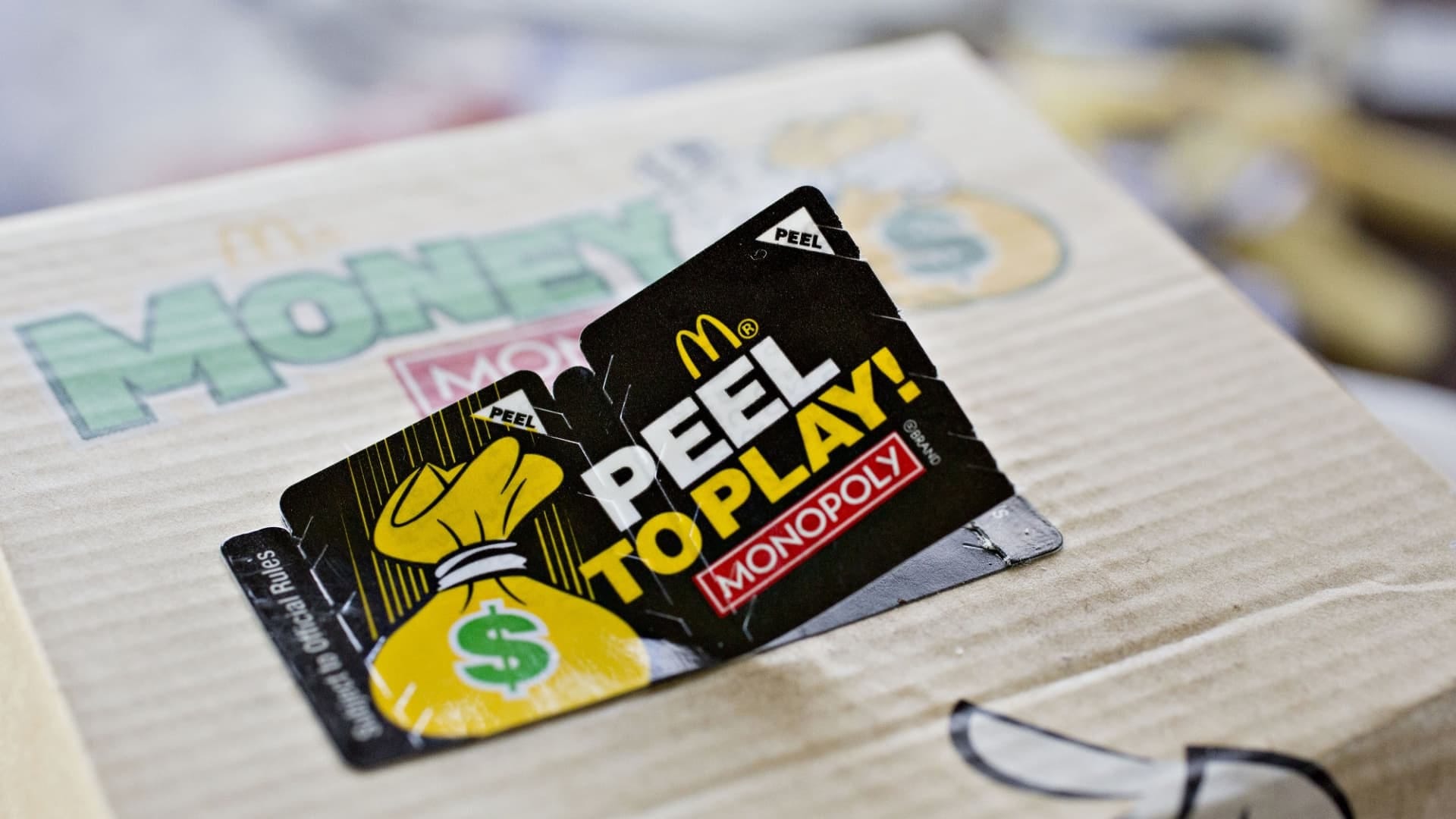
I was born in 1979. This is relevant only because it means that the McDonald’s Monopoly game was a formative part of my life. For those who are not familiar, the game which still exists today, was about peeling off tabs from fries, drinks etc in pursuit of Boardwalk and Park Place and riches! I remember fondly looking forward to the annual rollout of the game all the way through my high school years. Ironically, it turns out the game was mostly rigged but that’s for another story.
Gamification has been a part of restaurant loyalty since long before even 1987 when McD’s Monopoly game launched. What’s different, and terrifyingly new, is the proliferation of gambling and ‘prediction markets’ into nearly every aspect of life. My one prediction is that prediction markets and the gambling ethos will infiltrate restaurant loyalty in 2026.
While I’m pretty certain turning everything into a casino is a REALLY BAD IDEA, it’s happening so I wanted to better understand it. To do that it made sense to me to build a prediction market for Shy Bird. To be very clear, this is not our new loyalty program and won’t become it. This is equal parts satire, thought experiment with a dash of vibecoding geek-out/indulgence.
In design circles, there’s a tradition of building artifacts from futures you hope to avoid—not to celebrate them, but to make the possibility visceral enough to resist. When Charlie Brooker created Black Mirror’s “Nosedive” in 2016—a world where constant social ratings determine your access to housing, travel, and opportunity—he wasn’t endorsing the system. He was issuing a warning. Then China built it anyway. “It was quite trippy,” Brooker said. “I promise you we didn’t sell the idea to the Chinese government.” Consider this to be Shy Bird’s contribution to the genre.
Why is this happening now?
To understand why my Prediction (Prediction) isn’t paranoid fantasy, you have to understand the 3 forces converging to create a world where prediction markets graduate from “gambling apps” to critical financial and informational infrastructure. Restaurants move fast to reflect and refract what’s happening in broader society- hence the prediction.
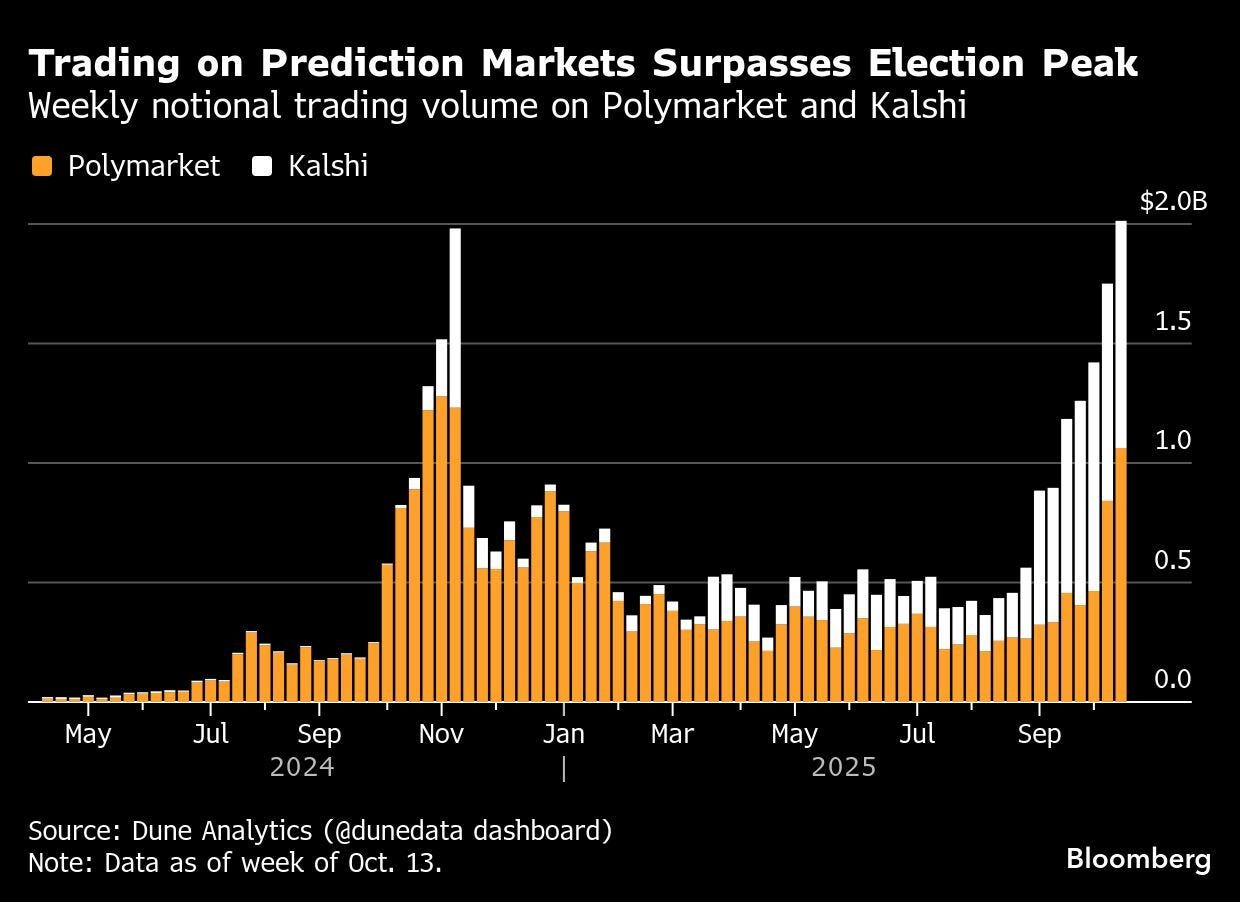
The financialization of truth. Platforms like Kalshi and Polymarket aren’t being valued like casinos anymore. Kalshi hit $11 billion in late 2025; Polymarket reached $8 billion—the highest valuation for a crypto-native consumer app since OpenSea’s peak. Major financial institutions are treating prediction markets as a new asset class, not for pricing bets but for pricing and settling reality itself. Silicon Valley Bank’s 2026 crypto outlook advises institutional clients to “treat crypto as infrastructure.” Prediction markets are becoming the rails.
The tax arbitrage nobody’s talking about. A provision buried in the 2025 “One Big Beautiful Bill Act” fundamentally altered the economics of gambling. By limiting loss deductions to 90%, it created what tax attorneys call a “phantom income” trap. A sports bettor who wins $200,000 and loses $200,000—breaking even—now owes taxes on $20,000 of income that doesn’t exist. Scale that up and the math becomes catastrophic. But federally regulated “event contracts” (prediction markets) use capital gains treatment, which sidesteps the trap entirely. The government accidentally created a massive subsidy for prediction markets. The smart money is migrating.
The AI imperative. As autonomous agents take over complex tasks—supply chain logistics, financial hedging, insurance payouts—they need trusted sources of truth to verify that events actually occurred. The web won’t cut it; it’s drowning in AI-generated hallucinations and SEO spam. A prediction market provides something different: a financially-staked, cryptographically-secured outcome. If participants have money on the line, the signal is harder to fake. Prediction markets become a machine-to-machine API for reality—not gambling infrastructure, but verification infrastructure.
These three forces—institutional capital, regulatory arbitrage, autonomous systems—create a flywheel. Prediction markets aren’t a curiosity anymore. They’re becoming plumbing.
Derek Thompson & “The Monks in the Casino”
The infrastructure is arriving. But who’s primed to use it?
Derek Thompson coined a phrase that’s stuck with me: “monks in the casino.” He’s describing a new archetype emerging among young men—people who find intimacy scary and gambling exciting. They furnish their rooms like high-tech monasteries, spend more time in solitary screen-based leisure than any previous generation, and gravitate toward media that works like a slot machine.
The data backs it up. Young, unmarried men now lead every demographic in “sedentary leisure time alone.” The share of young people attending or hosting social gatherings has declined roughly 70% in twenty years. Meanwhile, half of men aged 18-49 have a sports betting account. Risk-averse in the social sphere, risk-chasing in the financial one. Thompson calls it “a genuinely berserk modern life script.”
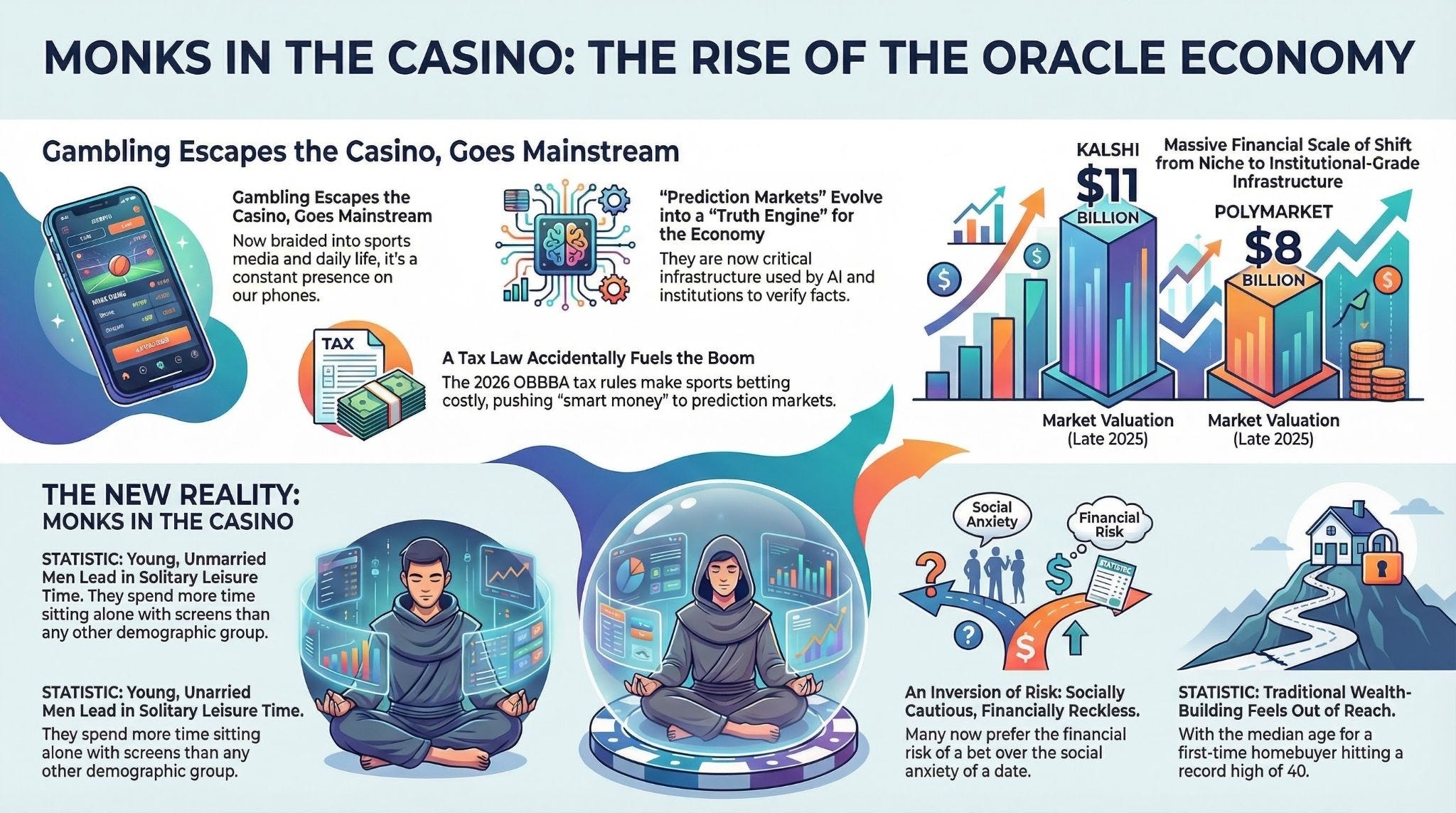
I recently wrote about why this Presentmaxxing mindset is actually pretty rational. Traditional wealth-building feels out of reach. The median age for a first-time homebuyer just hit a record high of 40. When the conventional path looks blocked, speculation starts to feel like the only viable route forward. As Thompson puts it: “Just as poor people buy lotto tickets when they feel their income is low relative to an implicit standard, perhaps young people today are drawn to get-rich-faster schemes precisely because middle-class hallmarks feel like luxuries.”
The supply side opportunity to bet on anything is arriving. The demand side is ready. What happens when they meet at a restaurant? Unfortunately I think it could look like a dude at home, alone on his laptop ordering food delivery on Doordash with points earned ‘betting’ on outcomes at Taco Bell.
Just Cause You Can Doesn’t Mean You Should
I’ve never enjoyed gambling. I am not risk averse and have some manageably addictive tendencies. I’ve wondered why I haven’t been more into gambling, but I’m not. Building a prediction market loyalty interface for Shy Bird is the first time I kind of got it. I felt something akin to what I imagine someone feels at the racetrack looking over a racing form. If I can discern enough of a pattern, I can beat the odds.
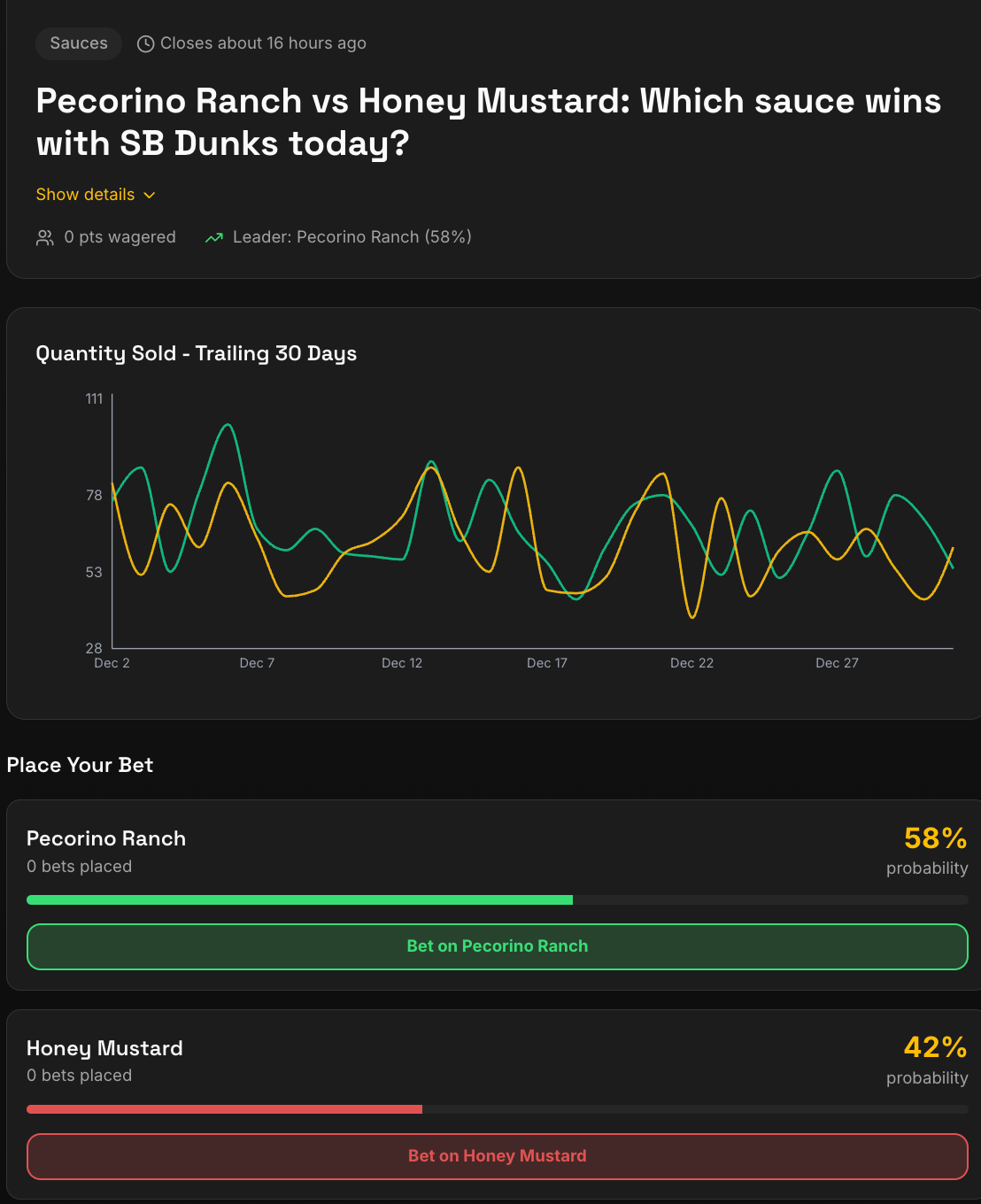
Polymarket and Kalshi are proving out that we have an appetite to bet on anything. There is currently a market on Polymarket for “ Logan Paul’s Pikachu Illustrator Sale Price” where $5M is a slight favorite over $6M across over a million dollars wagered. I always say, “if it works for Logan Paul, why not for a rotisserie restaurant in Boston.” So you can bet on things like Pecorino Ranch vs. Honey Mustard, the number of Calabrian Caesar Wraps sold or Maple Chipotle or Spiced Mushroom.
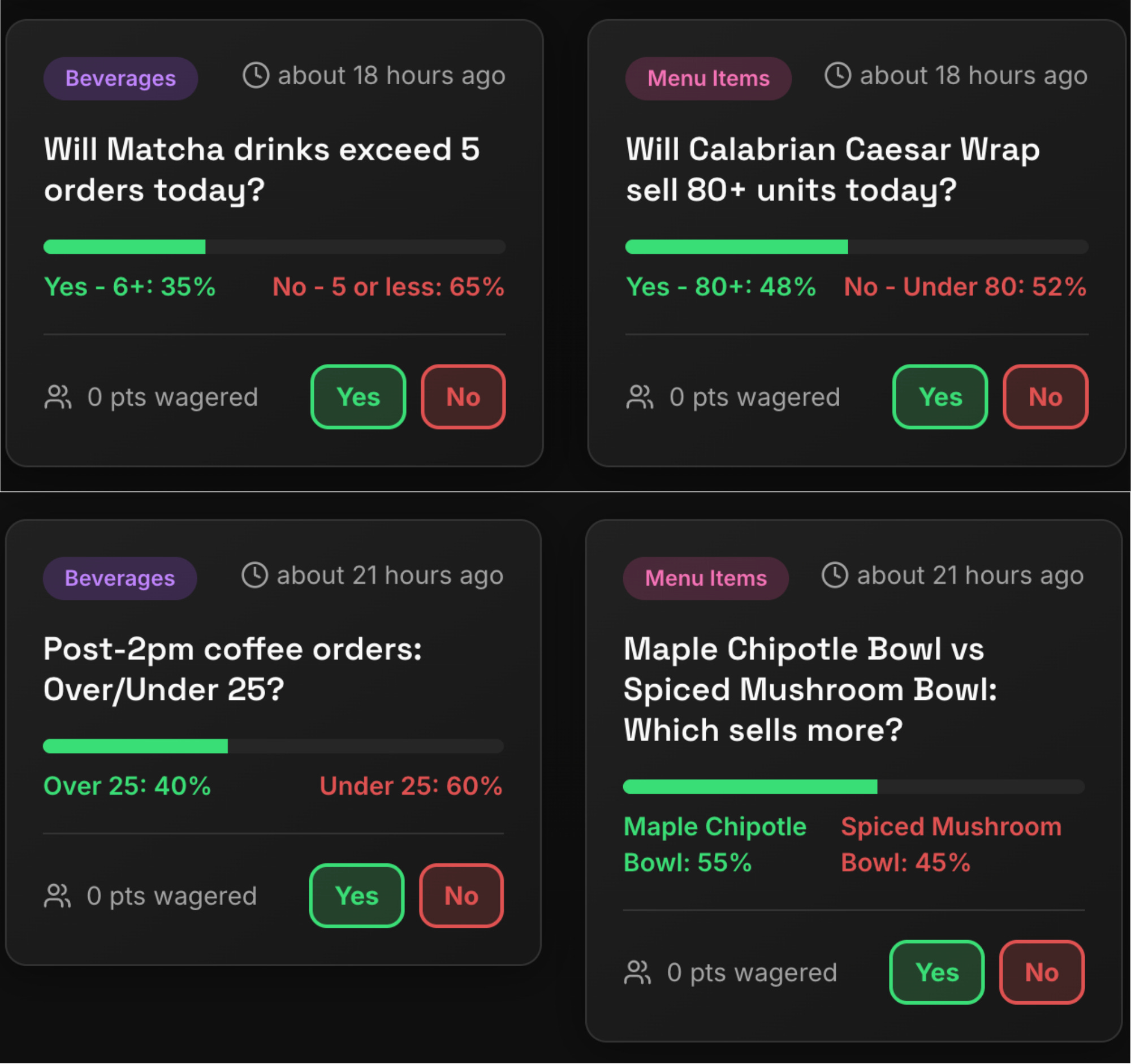
We had to add a little FOMO via a Live Feed of item sales along with a fake stream of bets coming. The items sales uses the actual Toast API to report item sales in real time. I imagine there are even more things we could do with the API to enrich the dopamine hits.
It looks pretty slick. It mostly works. That’s the problem.
No one our team writes code, is an expert in behavioral psychology, or studies brain chemistry. Historically, those would have prevented us from doing this even if we’d had the idea to. With AI those constraints vanish. A couple Polymarket screen shots, a Toast product mix upload, a prompt and a little over an hour of work and you’re there.
But just because you can, doesn’t mean you should.
![100+] Black Mirror Wallpapers | Wallpapers.com](https://substackcdn.com/image/fetch/$s_!FF1K!,f_auto,q_auto:good,fl_progressive:steep/https%3A%2F%2Fsubstack-post-media.s3.amazonaws.com%2Fpublic%2Fimages%2F81bff335-8358-401b-8dd0-4515cef4ba70_1920x1080.jpeg "100+] Black Mirror Wallpapers | Wallpapers.com")
Let’s Go Back to Black Mirror
Charlie Brooker, the show’s creator, has said repeatedly that it isn’t anti-technology. It’s anti-thoughtlessness. The phone is never the villain. The person holding it is. The show’s horror isn’t the invention—it’s the moment someone builds the thing without pausing to ask if they should.
That pause used to be built in. The friction was the thinking. You needed to know how to code, or understand behavioral psychology, or have access to capital and infrastructure. Those constraints weren’t obstacles—they were the deliberation that allowed time to talk yourself out of it.
Now the friction is gone.
The only constraint that remains is purely internal: a choice.