
The Infinity Industry

Before we jump in here, this one’s a little “think piece & navel gaze-y” but I couldn’t shake it. Thanks to the team at Toast for supporting it and I hope you’re here for it too!
I’ve been reading The Infinity Machine, the new biography of Demis Hassabis and DeepMind, and one thing keeps nagging me. Almost every milestone in the company’s rise happened inside a game with edges.
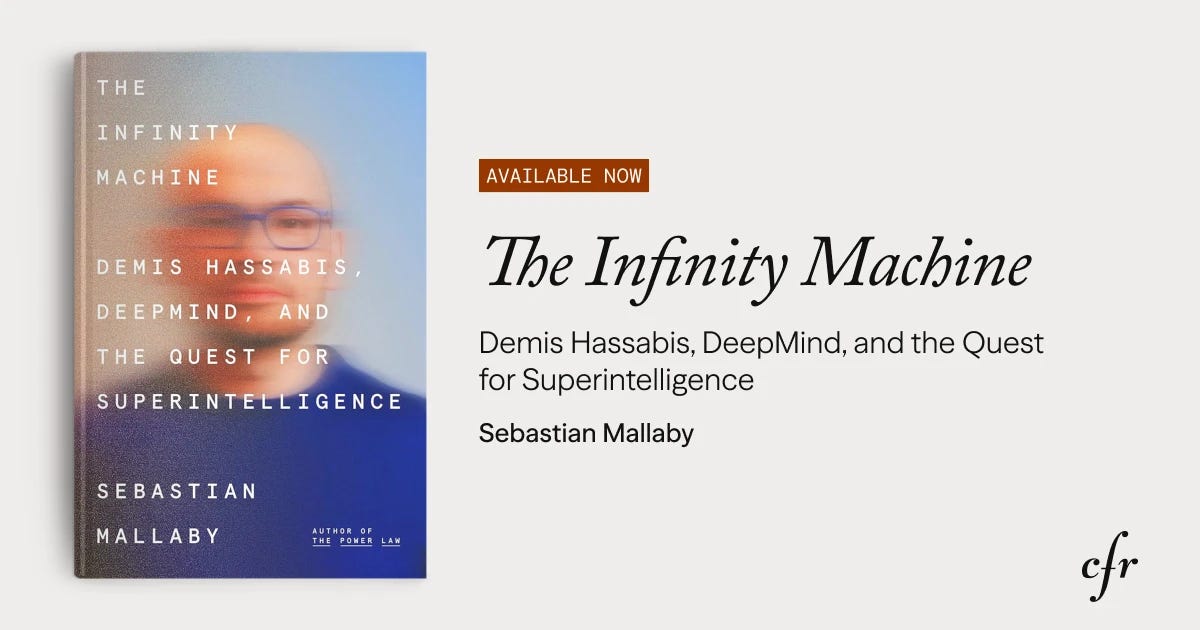
Chess. Go. Atari’s back catalog. Later, protein folding, which won Hassabis a Nobel and is closer to a puzzle than most people assume (there is a real answer, a folded shape that already exists in nature, and the machine’s job is to go find it). These are staggering achievements. They are also, every one of them, bounded. The board has a fixed size. The rules sit still while you think.
That assumption lives quietly underneath most of how we talk about artificial intelligence and the pursuit of Artificial General Intelligence, Artificial Superintelligence or whatever we’re calling it today. We measure the thing by handing it a closed world and clocking how fast it solves it. Deep Blue takes Kasparov. AlphaGo takes Lee Sedol. The headline writes itself, and the headline is always some version of the machine beat the human at the human’s own game.
But I keep coming back to a question that the chessboard can’t answer. What happens when there is no board?
Two kinds of games
The philosopher James Carse wrote Finite and Infinite Games in the 80’s. A finite game, Carse says, is played for the purpose of winning. It has agreed boundaries, a fixed roster, a moment where it ends. An infinite game is played for the purpose of continuing the play. The rules change as you go. The point is not to win. The point is to keep the game alive.
I think the key insight from the Simon Sinek video is that we move fluidly between finite and infinite games throughout our days. He gives an example of trying to win a client relationship as a finite game that, if you ‘WIN’ the client, becomes an infinite game of a relationship.
He doesn’t go here in the video but I’d argue a game can be finite and infinite at the same time- like a restaurant. It’s a finite game of profit outcome concurrent with multi-dimensional infinite games happening involving employees, guests and communities.
At Shy Bird there is no clear win condition. There is no Tuesday where we ‘win restaurant’ and get to stop and celebrate. Every morning the constraints rearrange themselves. A purveyor’s truck is late. The weather flipped and the patio math changed with it. A line cook called out. A four-top turned into a seven-top.
This is why I think restaurants might be a way better benchmark for machine intelligence. Chess, Go and Shogi are hard the way a mountain is hard. It is enormous, but it holds still. A restaurant is hard the way the ocean is hard. It will not hold still, it does not care about your model of it, and the moment you think you’ve mastered it, something changes.
The variable with a pulse
Ok- even I have my limits when it comes to navel gazing. What’s something tangible and practical to hang this on? In an admittedly abstract and edge use case of Toast IQ, I gave it a draft of this piece and the following prompt: “Read this and then respond with statistical anecdotes that represent this tension and complexity”
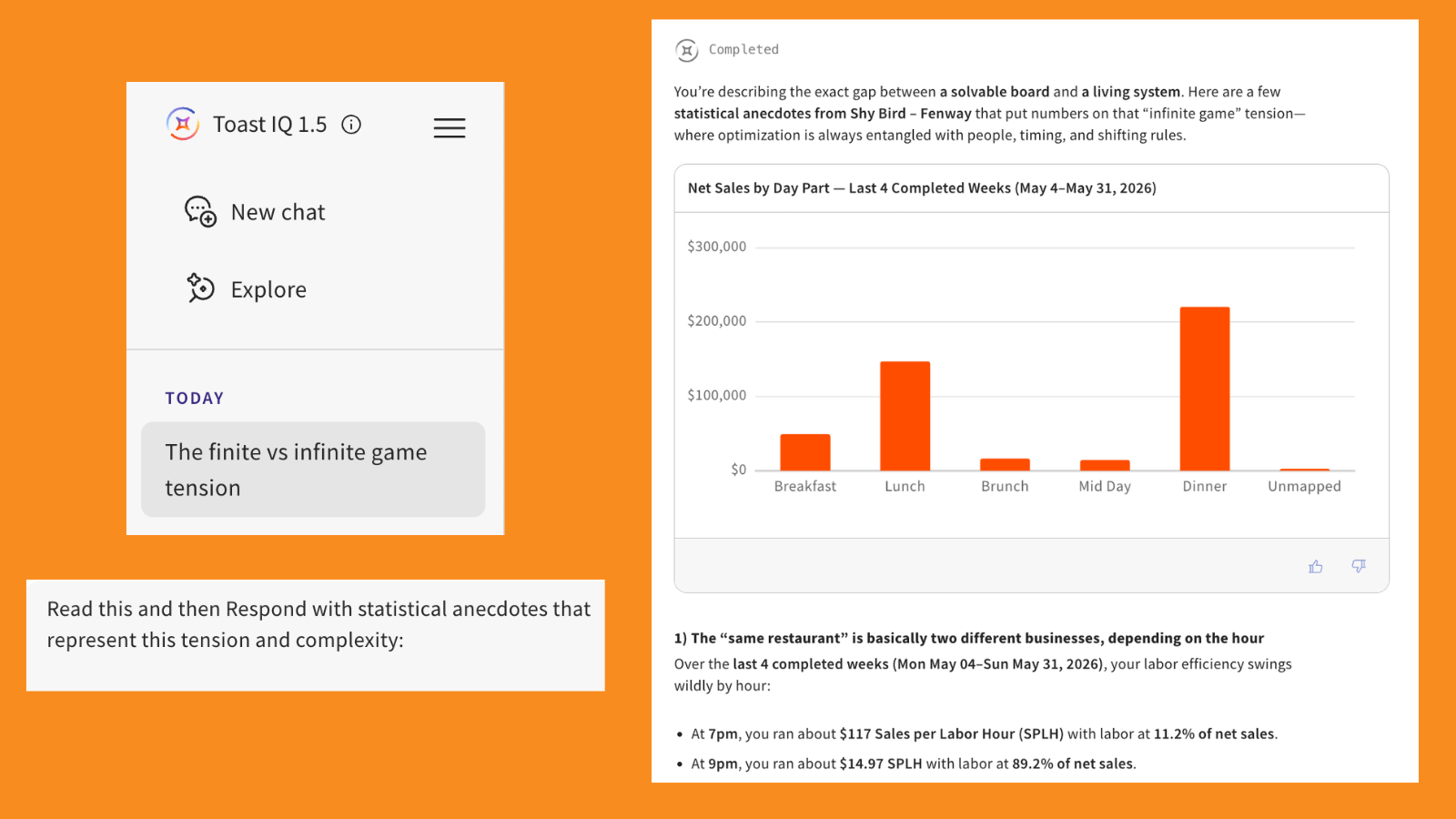
There were 3 additional grounded examples that followed number one above. These types of uses if AI might seem silly, but I believe they are important to help operators understand the sometimes alien capabilities of their current tech tools, to say nothing of what’s to come.
For me, the clearest example of finite and infinite games in a restaurant is the balance of managing labor costs (finite) and taking care of our people (infinite). We have all the inputs you’d want. Time-entry data. POS sales by daypart and hour. Well informed schedule pars. On paper it looks like the sort of optimization problem a sufficiently smart system should be able to crush. Feed it the numbers, get back the schedule.
It doesn’t work that way because the finite game is in direct tension with the infinite game.
Labor is the single largest line item on most restaurant P&Ls. It is also, and this is the part the spreadsheet politely declines to mention, a list of people’s rent. Those two facts sit on top of each other and refuse to reconcile. You can drive labor cost down- the mechanics are pretty clear. You cut hours or you cut bodies (ugh, hate this term but using it for effect). And the instant you cut hours, you have reached into someone’s life and taken money they were counting on. The line item you most need to manage is also a column of human beings who go home to families.
A finite game doesn’t ask you to feel anything about the pawns. You sacrifice the pawn to protect the king and the pawn does not have a kid in daycare. An infinite game has nothing but pawns who are also kings, all at once, all the time.
So the real benchmark is not “can the system shave fifteen percent off labor.” Any decent model can do that, perhaps degrading everything that made the place worth visiting or working at in the process. The serious test, the one I’d actually call intelligence, sounds more like this. Can the system help restructure the operation so completely that labor becomes more productive and people take home more, at the same time? Can it watch a Saturday rush build in real time, absorb a call-out, notice that the food starts slipping when the line is one person short, and adapt the night without quietly trading away either the team’s morale or the guest’s experience?
That system requires invention, empathy and arithmetic. In that system you’d likely have to rethink prep workflows, station design, maybe the menu itself. That system would aim to reduce the cognitive load on the people doing the work while, paradoxically, deepening their engagement in it. There is no formula waiting at the bottom of that problem. There is only judgment, applied over and over, under conditions that never repeat.
Keep the game going
I don’t think a machine running a profitable, humane restaurant is around the corner. It’s also not what any of us should hope for. But a restaurant, with all the tension of finite and infinite games being played concurrently, is a more honest measuring stick than a board game or Erdos problem, because it refuses to let intelligence off easy. It insists that the real world is open, crowded with stakeholders who all want different things (staff, guests, purveyors, landlords, the version of you that has to look the team in the eye on payday), and that none of it ever resolves into a tidy win.
Hassabis built his life’s work on the elegant beauty of games you can finish. I love that work. I also love the book and added it to my ever-evolving resources list. I also think the real benchmark for AGI is a real world game with no edges, no whistle, no final move on the board and one where we are all stakeholders.
That, to me, is the restaurant industry…the infinity industry.